Aggressive Dog Training and Behavioral Development
Behavior
Correction
Behavioral Development looks at what is driving the unwanted behavior and what happens before it escalates. Understanding those patterns helps us address the behavior more effectively instead of reacting after the fact.
Behaviors We Address
- Reactivity
- Barking and lunging
- Growling or snapping
- Resource guarding
What We Look For
- Common triggers
- Early warning signs
- Escalation patterns
- Repeated behavioral responses
Real
Control
Dogs may follow commands in a quiet setting but struggle when the environment becomes more demanding. We focus on applying obedience when distractions, activity, and environmental pressure increase.
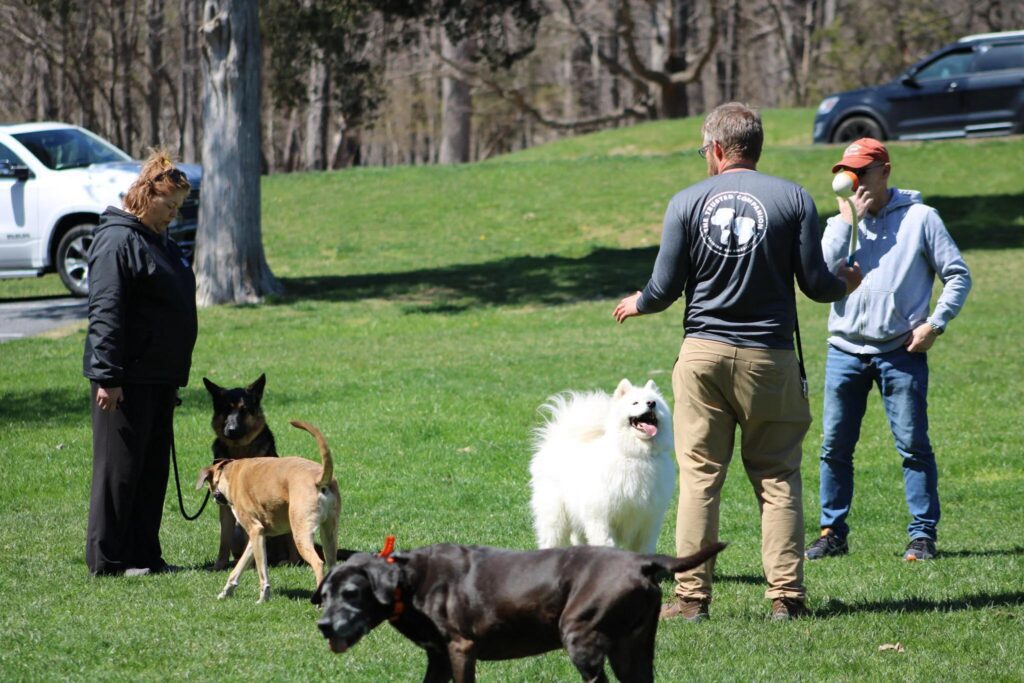
In this phase, we teach dogs how to remain stable under stress, distractions, and environmental pressure.
Control becomes dependable because communication becomes clear.
What We Work On
- Staying responsive around triggers
- Following commands under distraction
- Disengaging from people, dogs, or objects
- Recovering more quickly after stress
- Maintaining impulse control in difficult situations
What Better Control Can Look Like
- Calmer walks
- More manageable greetings
- Better behavior around other dogs
- More predictable responses in public
What Owners Learn
- Giving clear commands
- Setting consistent boundaries
- Improving timing
- Following through
Owner
Leadership
Training continues after the session ends. Owners need to apply the same expectations throughout the dog’s daily routine so lessons remain consistent from one situation to the next.

Service Areas in
Tampa Bay
Our dog training programs are available throughout Tampa Bay, Florida and surrounding communities including Tampa, St. Petersburg, Clearwater, Wesley Chapel, and Spring Hill.

Why Is My Dog Showing Aggressive or Reactive Behavior?
There is no single explanation for aggression or reactivity. Dogs can respond strongly to people, animals, objects, handling, environments, or situations for different reasons.
Common triggers and contributing factors may include fear, territorial behavior, resource guarding, frustration, overstimulation, poor impulse control, inconsistent expectations, and limited or inappropriate social experiences. Dogs can also develop behavioral patterns because those behaviors have worked for them before.
For example, a dog may bark and lunge when another dog approaches. If the other dog then moves away, that reaction may become a repeated response to similar encounters.
Owners also need to learn what happens before the obvious reaction. Staring, fixation, stiffness, avoidance, changes in posture, or increasing excitement may signal that a dog is becoming uncomfortable or overstimulated. Recognizing these signs early gives owners a better chance to step in before the behavior escalates.
Sudden behavioral changes deserve immediate attention. If your dog’s behavior changes unexpectedly, especially around handling or physical contact, speak with your veterinarian about whether pain or another medical issue could be a contributing factor.
When Should You Get Professional Help for Aggressive Behavior?
You do not have to wait for a serious incident before asking for help. Repeated or escalating behavior can be reason enough to have your dog evaluated.
Consider professional aggressive dog training if your dog:
- Regularly growls, lunges, or snaps
- Becomes difficult to control around people or dogs
- Guards food, toys, furniture, spaces, or other resources
- Fixates on triggers and struggles to disengage
- Escalates rapidly when frustrated or overstimulated
- Makes walks, visitors, or public outings difficult to manage
- Has bitten or attempted to bite a person or animal
If an aggressive incident has already occurred, give the trainer an accurate account of what happened. Details about what occurred before, during, and after the incident can provide important context.
Getting professional guidance can help you better understand what you are seeing and what needs to change. The objective is to create a clearer, more consistent way for you and your dog to move forward.
How Does Our Aggressive Dog Training Work?
Our goal is to build behavioral patterns that owners can reinforce during everyday life.
Training begins by establishing clearer expectations. The dog needs to understand what is being asked, and the owner needs a dependable way to communicate it. From there, we work on obedience, impulse control, appropriate responses, and staying under control as distractions increase.
That progression matters. A dog that follows commands in a quiet living room may respond very differently when another dog appears outside. Visitors, traffic, unfamiliar environments, other animals, and excitement can all increase pressure.
Training therefore needs to move beyond ideal conditions. Depending on the dog’s needs, work may involve practicing around appropriate distractions and applying obedience in situations similar to those the owner encounters in everyday life.
Corrections may also be used when appropriate. They should be timely, fair, and purposeful – never driven by anger or frustration. Clear expectations come first so the dog has an opportunity to understand the desired response.
The result we are working toward is not obedience that exists only when a trainer is present. We want owners to have practical skills they can use at home, on walks, in public, and wherever behavioral problems are most likely to occur.
Train the Human. The Dog Follows.
You live with your dog. Your trainer does not.
That is why owner education is a central part of our approach. A professional trainer can establish skills and work on behavioral patterns, but what happens during the rest of the week matters just as much.
Dogs receive information from their owners throughout the day. The commands you give, the behaviors you interrupt, the rules you enforce, and the behaviors you allow all shape expectations. When those expectations continually change, it becomes harder to encourage dependable responses.
We teach owners how to:
- Recognize behavioral escalation
- Give clear commands and expectations
- Improve timing and follow-through
- Interrupt unwanted behaviors appropriately
- Create structure at home
- Remain consistent across different situations
- Handle distractions with greater confidence
This is also why our philosophy is not built around treats, clickers, or gimmicks. The owner needs a form of communication that remains useful when the dog is distracted, excited, stressed, or focused on a trigger.
Train the Human. The Dog Follows.
What Does Progress Look Like?
Progress with reactive dogs and aggressive dogs is not measured by a single good day. We look for practical changes in how the dog responds and how effectively the owner can manage challenging situations.
Depending on the dog’s starting point, training may work toward:
- Greater neutrality around triggers
- Better impulse control
- Faster recovery after excitement or stress
- More consistent responses to the owner
- Improved obedience around distractions
- Calmer behavior in everyday situations
- Greater real-world stability
Progress may also mean that an owner recognizes escalation sooner and can respond before the dog’s behavior reaches the same intensity. Those changes can make difficult situations more predictable and manageable.
Every case is different. The dog’s history, severity of the behavior, triggers, existing obedience, and consistency outside of training can all affect progress. We do not assume that every dog will reach the same point on the same timeline.
What Happens Before Training Begins?
The process generally starts with a phone consultation. Tell us what has been happening, when you notice the behavior, what appears to trigger it, and what you have already tried.
Most prospective clients then move forward with a $50 Initial Handling Session.
This gives our trainer a closer look at your dog’s behavior, current obedience, and how your dog responds in a familiar environment. It also gives you a chance to discuss your goals, ask questions, and better understand what type of training may be appropriate.
What Training Options Are Available?
AlphA and Omega Dog Training operates as a mobile dog training service. We work with clients in their homes and appropriate real-world environments, giving us a better understanding of the routines, interactions, and situations surrounding the behavior.
During the initial evaluation, we consider your dog’s behavioral history, known triggers, current obedience, response to you, household routines, and your desired outcomes. From there, we can recommend the training format that best fits your situation.
Our dog training services include private in-home training and Board and Train programs. The right option depends on your dog, the behaviors you are addressing, and the level of support needed.
Private training gives you direct involvement as you learn how to apply the training yourself. Board and Train provides a more concentrated environment where professional trainers work directly with your dog. In either format, owner education remains important because the skills need to carry over into everyday life.
Frequently Asked Questions About Aggressive Dog Training
Can aggressive dogs be trained?
Yes. Aggressive dogs can learn improved obedience, impulse control, and responses to their owners. However, aggression varies in cause and severity. The right training approach depends on the dog’s history, triggers, current behavior, and individual needs.
What is the difference between an aggressive dog and a reactive dog?
Reactivity is an excessive response to a trigger and may involve barking, lunging, pulling, or intense fixation. Aggressive behavior may include growling, snapping, biting, or other threatening behavior. The two can overlap, which is why evaluating the circumstances surrounding the behavior is important.
How should I reinforce training at home?
Consistency at home is an important part of behavioral training. Owners should follow the same commands, boundaries, and expectations introduced during training so the dog receives a clear message from everyone in the household. Short, regular practice in everyday situations can help strengthen what the dog is learning.
Can you work with a dog that has bitten someone?
Yes. AlphA and Omega Dog Training works with dogs that have a bite history. During the initial consultation, we’ll ask about what happened, what led up to the incident, and whether similar behavior has occurred before. That information helps us understand the severity of the behavior and determine the appropriate training approach.
Should everyone in my household participate in the training?
Ideally, yes. Anyone who regularly interacts with or handles your dog should understand the commands, boundaries, and expectations used during training. This helps reduce mixed signals and makes it easier to reinforce the same behaviors throughout the day.
Get Help with Your Dog’s Behavior
Aggression and reactivity can affect walks, visitors, family routines, and your ability to comfortably take your dog into the world. You need more than a temporary solution. You need to understand what your dog is communicating and know how to respond.
Start with a phone consultation with AlphA and Omega Dog Training. From there, we can schedule an in-home evaluation and determine the appropriate next step for you and your dog.